

You wake up in your Los Angeles home, the sun is streaming through the window, and the first thing you feel isn't refreshed: it’s "stuck." That agonizing, creaky, "I-can’t-bend-over-to-brush-my-teeth" stiffness in your lower back is a brutal way to start the day.
If you’ve been blaming your age or "just a bad night's sleep," you are missing the bigger picture. Morning back stiffness isn't just an annoyance; it is your body screaming that your structural alignment is failing. In a city like LA, where we spend half our lives in traffic on the 405 and the other half hunched over laptops, this stiffness is an epidemic.
At Life Rx- PhysioMassage Therapy Los Angeles, we don't just "rub muscles." We solve the structural puzzles that keep you stiff. Here are the 10 astounding reasons your morning back stiffness won't go away: and the clinical path to fixing it forever.
1. NOCTURNAL DISC HYDRATION
Your spinal discs are like sponges. During the day, gravity compresses them. At night, while you sleep, they rehydrate and expand. This sounds good, right? Not necessarily. If you have any underlying disc thinning or minor bulges, this astounding expansion increases internal pressure. When you take those first steps in the morning, that extra fluid creates substantial tension against sensitized nerves. This is why you feel like a "tight spring" for the first 30 minutes of the day.
2. OVERNIGHT INFLAMMATION ACCUMULATION
Inflammation is a silent thief. When you are stationary for 7 to 8 hours, your circulation slows to a crawl. In areas where you have existing micro-trauma: likely your lower back: inflammatory chemicals pool in the tissues. Without the "pump" of movement to flush them out, you wake up with a chemical soup irritating your nerve endings. This is why "moving around" eventually helps; you are manually jump-starting your internal drainage system.
3. THE "SITTING SICKNESS" ADAPTATION
If you spend your day at a desk in Santa Monica or commuting to Glendale, your body adapts to that seated shape. Your hip flexors shorten, and your glutes "turn off." When you lay down at night, your body doesn't magically reset. Those shortened muscles pull on your pelvis all night long, putting your lower back under a constant, low-level strain. You aren't resting; you are essentially in a 8-hour tug-of-war with your own anatomy.

4. COMPROMISED SLEEP ARCHITECTURE
Are you a stomach sleeper? If so, you are essentially "wringing out" your spine like a wet towel for hours on end. This position forces your lower back into an exaggerated arch (extension), compressing the facet joints of your vertebrae. By the time the alarm goes off, those joints are inflamed and angry. Even side-sleeping without a pillow between your knees can cause your top leg to pull your pelvis into a rotation, twisting your lumbar spine until sunrise.
5. MYOFASCIAL ADHESIONS: THE "BODY SUIT" PROBLEM
Think of your fascia as a thin, slippery bodysuit under your skin. In a healthy body, it glides. In a stiff body, it gets "sticky." Over time, areas of high stress develop adhesions, basically internal scar tissue: that glue your muscles together. Overnight, these adhesions tighten up. When you try to move in the morning, you are trying to stretch a bodysuit that is two sizes too small. Standard massage barely touches this; you need PhysioMassage to manually break these bonds.
6. CORE MUSCLE AMNESIA
Your "core" isn't just your abs; it’s a sophisticated bracing system. If these muscles have "forgotten" how to fire correctly due to sedentary lifestyles, your lower back has to do all the heavy lifting. While you sleep, these deep stabilizers go completely offline. When you stand up, your spine has zero support, leading to an immediate, protective "clamping" of the back muscles to prevent injury. That "clamping" is the stiffness you feel.
7. PELVIC TILT IMBALANCES
Most people in Los Angeles suffer from an "Anterior Pelvic Tilt": where the pelvis dips forward like a spilled bucket of water. This is caused by tight quads and weak hamstrings. This tilt creates a permanent "kink" in your lower back. No matter how much you "relax" at night, that structural kink remains. You wake up stiff because your bones are literally in the wrong place.
8. CHRONIC DEHYDRATION
Your fascia and discs require water to stay elastic. If you’re living on espresso and forgetting your water bottle, your tissues become brittle. Think of a dried-out sponge vs. a wet one. The dried-out version cracks when you bend it. Your lower back is no different. If you aren't hydrating at a cellular level, your morning "creaks" are the literal sound of dehydrated tissue struggling to move.
9. MICROTRAUMA FROM OLD INJURIES
That "minor" sports injury from five years ago or that fender bender on the 101 left behind a legacy. Your body builds protective layers of tension around old injury sites. This "guarding" becomes your new baseline. At night, when your conscious mind turns off, your nervous system stays on high alert, keeping those muscles partially contracted. You wake up exhausted and stiff because your back never truly "let go."
10. THE CORTISOL SPIKE
Your body naturally releases cortisol in the early morning hours to help you wake up. However, cortisol is also a pro-inflammatory hormone. If you are already dealing with high stress, this morning spike can exacerbate existing sensitivities in your back. It’s a physical manifestation of your body’s "fight or flight" response, tightening the large muscles of the back before your feet even hit the floor.

WHY YOUR SPA MASSAGE IS FAILING YOU
Most people respond to back stiffness by booking a "relaxing" Swedish massage at a local spa. While that feels nice for an hour, it is a band-aid on a bullet wound. A spa massage focuses on the surface. It rubs the skin and provides temporary relaxation, but it does nothing to address the 10 reasons listed above.
To fix morning stiffness, you don't need "relaxation": you need correction.
At Life Rx- PhysioMassage Therapy Los Angeles, we offer a premium pain and posture therapy experience built on a clinical system. We don't just rub your back; we re-engineer it.
THE PHYSIOMASSAGE SOLUTION: ASSESS, TREAT, REASSESS
We have defined a new category of care. Our PhysioMassage is a structured corrective therapy process that goes beyond the standard "hourly service." Here is how we get you moving again:
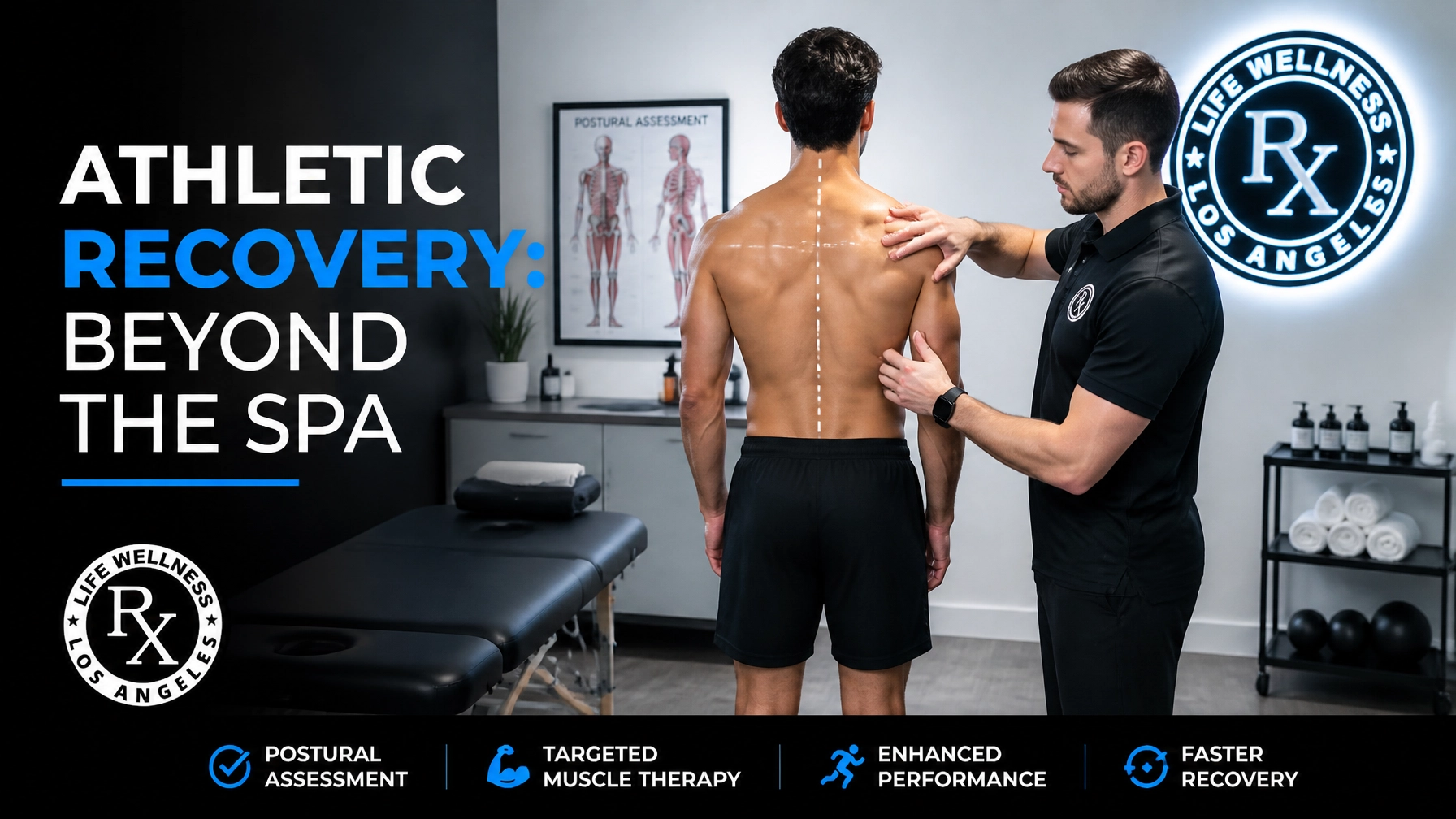
- ASSESSMENT: We start by testing your movement. Where is the pelvis tilted? Which muscles are "offline"? We find the root cause, not just the symptom.
- TARGETED TREATMENT: Using a unique fusion of sports massage, medical manual therapy, and physical therapy techniques, we break down adhesions and restore muscle length.
- REASSESSMENT: We don't just hope it worked. We re-test your movement immediately to ensure the "kink" in your spine is gone.
- RECOVERY PLAN: We provide you with a long-term plan to stay out of pain, including postural corrections tailored to your specific LA lifestyle.
Whether you visit our Glendale clinic or utilize our on-demand medical massage at home in Los Angeles, you are receiving a results-driven system designed to restore movement.

STOP WAKING UP IN PAIN
You do not have to accept morning stiffness as your "new normal." The results our clients see are often astounding and substantial. Imagine swinging your legs out of bed and standing up with zero hesitation. Imagine a day that starts with energy instead of a search for the Advil bottle.
This is not a regular massage. This is PhysioMassage: assess the issue, treat the cause, retest the body, and build a recovery path.
ARE YOU READY TO RESET YOUR POSTURE AND ELIMINATE STIFFNESS?
Book your session now: Book The Session
Watch our corrective techniques in action: Watch Our Class
Get deeper insights into spinal health: Masterclass on Patreon
CALL US TODAY TO SCHEDULE YOUR IN-HOME OR CLINIC SESSION: (209) 273-5376
Life Rx- PhysioMassage Therapy Los Angeles: Assessment. Treatment. Reassessment. Recovery plan. Serving Los Angeles, Beverly Hills, Glendale, and surrounding areas.




Leave A Comment