


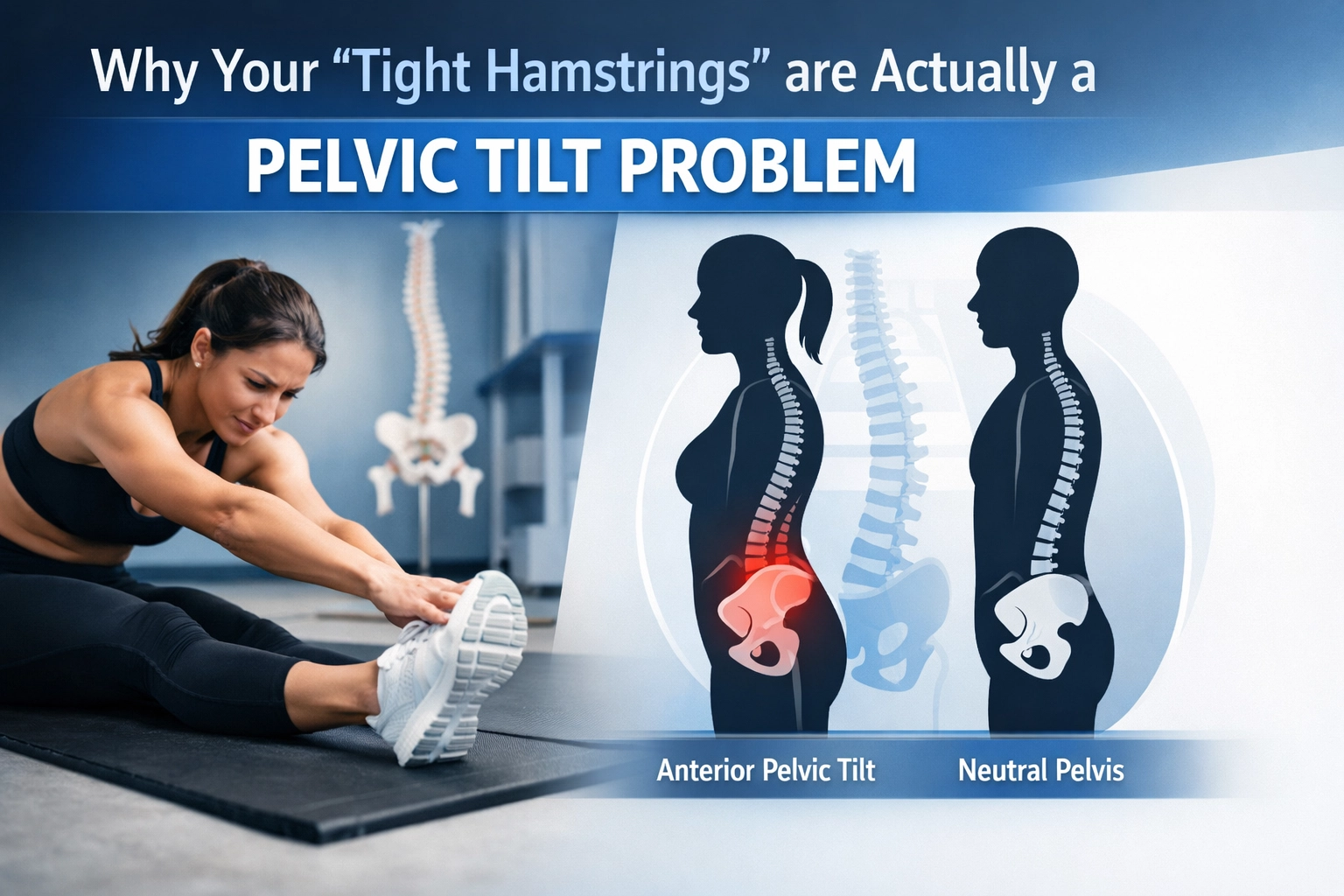
You stretch your hamstrings every single day. You've done the yoga poses, the foam rolling, the standing forward folds, sometimes twice a day. Yet here you are, months later, and those hamstrings still feel like guitar strings pulled to their breaking point.
Here's the plot twist: your hamstrings aren't actually tight. They're just screaming because your pelvis has been tilted forward like a bucket spilling water, and nobody's bothering to fix the bucket.
Welcome to the most common misdiagnosis in the world of chronic pain. Let's solve this mystery together.
THE HAMSTRING PARADOX: TIGHT BUT NOT SHORT
When you feel that pulling sensation behind your thighs, your brain immediately thinks: "These muscles are short and need stretching." It's logical. It's intuitive. And it's completely backwards.
Here's what's really happening: In anterior pelvic tilt (APT), your pelvis tips forward at the top, which creates a chain reaction down your entire posterior chain. Your hamstrings attach to the bottom of your pelvis (the ischial tuberosity, if we're being fancy), and when that pelvis dumps forward, it yanks those hamstrings into a pre-stretched position, like a rubber band that's already pulled taut before you even touch it.
The sensation you interpret as "tightness" is actually neurological tension, not mechanical shortness. Your hamstrings are sending distress signals because they're working overtime trying to stabilize a pelvis that's constantly trying to tip forward. They're exhausted, over-lengthened, and frankly, a little annoyed that you keep trying to stretch them even more.

THE REAL CULPRITS: YOUR HIP FLEXORS AND WEAK GLUTES
So if the hamstrings aren't the problem, who's the villain in this story? Meet your hip flexors, specifically the iliopsoas, rectus femoris, and TFL (tensor fasciae latae). These muscles live on the front of your hip and thigh, and when they get chronically tight from sitting all day (hello, desk job), they pull your pelvis into that forward tilt position.
Think of it this way: Your pelvis is like a bowl of water balanced between two opposing muscle groups. The hip flexors on the front pull it forward; the hamstrings and glutes on the back pull it backward. When your hip flexors are short and tight, and your glutes are weak and underactive (thanks, Netflix marathons), the bowl tips forward and spills.
The kicker? Every time you stretch those already-lengthened hamstrings, you're actually making the problem worse. Research confirms that hamstring stretching can increase anterior pelvic tilt during walking, bending, and standing. You're literally training your body to stay in the dysfunctional pattern.
WHY YOUR STRETCHING ROUTINE IS BACKFIRING
Let's talk about what happens when you aggressively stretch muscles that are already over-lengthened:
1. You Increase the Pelvic Tilt: Lengthening the hamstrings even more allows the pelvis to tip further forward, which tightens your lower back muscles as they compensate to keep you upright.
2. You Create Weak, Ineffective Hamstrings: Over-stretched muscles become long and weak, losing their ability to generate force and stabilize your pelvis. Now you've got hamstrings that can't do their job.
3. You Risk Micro-Tears and Chronic Irritation: Constantly stretching tissue that's already at its mechanical limit can cause small tears and inflammation, which, surprise, feels like tightness.
This is why people end up in a frustrating cycle: stretch the hamstrings, feel temporary relief, then wake up the next morning with the same tightness (or worse). You're treating the symptom, not the cause.
THE POSTURAL DETECTIVE APPROACH: INVESTIGATING THE REAL PROBLEM
At PhysioMassage Los Angeles, we don't just rub where it hurts and call it a day. We put on our detective hats and investigate the entire kinetic chain. When you come in complaining about tight hamstrings, here's what we're actually looking for:
Hip Flexor Length: Are your quads, psoas, and TFL pulling your pelvis forward? (Spoiler: Usually, yes.)
Glute Activation: Can you actually fire your glutes properly, or are they on permanent vacation while your hamstrings do all the work?
Core Stability: Is your core strong enough to maintain neutral pelvic alignment, or is your lower back arching like a scared cat?
Movement Patterns: How do you sit, stand, walk, and hinge? Are you reinforcing the pelvic tilt in everything you do?
This is the Postural Detective methodology, we don't just look at the crime scene (your hamstrings); we track down the suspect (your anterior chain), investigate the motive (weak posterior chain), and solve the case at its root.

THE PHYSIOMASSAGE SOLUTION: RELEASE, RESET, RESTORE
Here's how we actually fix the problem instead of putting a band-aid on it:
STEP 1: RELEASE THE ANTERIOR CHAIN
We use manual therapy techniques to release the tight hip flexors, quads, and anterior hip capsule that are pulling your pelvis forward. This isn't a relaxation massage, this is clinical, targeted work that addresses the mechanical restrictions creating the tilt.
STEP 2: RESET THE PELVIC FOUNDATION
Once we've released the front, we work on re-educating your pelvis to find and maintain a neutral position. This involves manual techniques to decompress the lower back, activate dormant glutes, and restore proper movement patterns.
STEP 3: STRENGTHEN WHAT'S WEAK
Here's the truth bomb: You need to strengthen your hamstrings, not stretch them. Strong hamstrings pull your pelvis back into alignment and stabilize your lower back. We teach you corrective exercises that target posterior chain strength without reinforcing the dysfunctional pattern.
The result? Your hamstrings stop feeling "tight" because they're no longer fighting a losing battle against a forward-tilted pelvis. You get lasting relief instead of temporary improvement.
WHAT THIS LOOKS LIKE IN REAL LIFE
Let's say you're a software engineer in Los Angeles (because let's be honest, half the city is). You sit 8-10 hours a day, your hip flexors are tighter than your deadline schedule, and your glutes have basically ghosted you. Every time you stand up, your hamstrings scream.
You've tried:
- Yoga (felt good in the moment, tight the next day)
- Foam rolling (painful and ineffective)
- Stretching before bed (still wake up stiff)
- Generic sports massage (temporary relief at best)
What you haven't tried is fixing the pelvis. That's where PhysioMassage comes in.
In your first session, we identify the anterior pelvic tilt, release those chronically tight hip flexors, decompress your lower back, and teach you how to activate your glutes properly. You walk out feeling lighter, taller, and like your hamstrings just took their first real breath in years.
This isn't magic, it's biomechanics.
WHY IN-HOME SESSIONS CHANGE THE GAME
One of the biggest advantages of PhysioMassage Los Angeles is our in-home service. Why does this matter for pelvic tilt issues?
1. We See Your Real Environment: We can assess how you sit at your actual desk, where you're compensating in your daily movement patterns, and what environmental factors are contributing to your dysfunction.
2. Zero Commute Stress: Lower back pain and hip pain hate car rides. Why make yourself uncomfortable getting to therapy when we can come to you?
3. Post-Session Recovery: After we reset your pelvis and release those hip flexors, you can immediately rest in your own space instead of sitting in LA traffic undoing half the work.
We serve the entire Los Angeles area, including North Hollywood, Hollywood, West Hollywood, and surrounding neighborhoods.
PRICING: REAL SOLUTIONS, TRANSPARENT COSTS
In-Home PhysioMassage: $220 per session
Clinic Sessions (Glendale): $140 per session
Yes, it's an investment. But consider what you've already spent on foam rollers, yoga classes, generic massages, and chiropractor visits that haven't solved the problem. One properly executed PhysioMassage session addresses the root cause: not just the symptom.
READY TO FIX THE TILT INSTEAD OF STRETCHING THE SYMPTOM?
Stop wasting time on hamstring stretches that make the problem worse. Let's investigate what's really going on with your pelvis and create a plan that actually works.
Book your PhysioMassage session today:
📞 Call or text: (209) 273-5376
🌐 Online booking: https://massagerxla.com/
Want to learn more about how postural dysfunction creates pain patterns? Check out our educational content:
📺 Watch Our Class on YouTube
🎓 Access Our Masterclass on Patreon
THE BOTTOM LINE
Your hamstrings don't need more stretching: they need your pelvis to stop pulling them into dysfunction. The "tightness" you feel is a symptom, not the disease. Fix the pelvic tilt, release the hip flexors, strengthen the posterior chain, and watch those hamstrings finally relax for the first time in years.
Stop stretching what's already long. Fix the tilt. Solve the problem.
That's the PhysioMassage difference: and that's how we help people in Los Angeles finally break free from chronic pain patterns that nobody else could solve.
Your pelvis has been trying to tell you something. Maybe it's time to listen.






Leave A Comment