
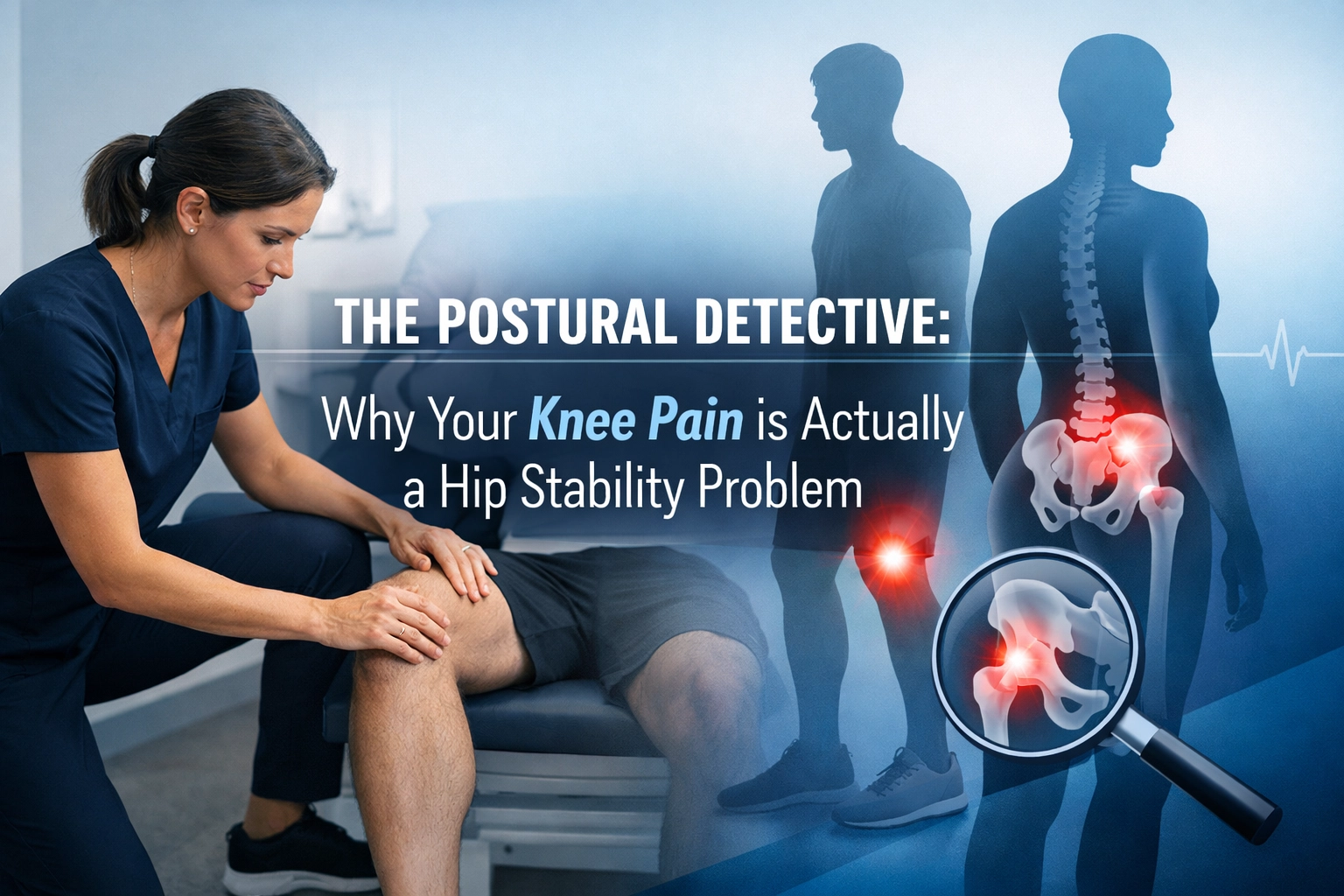
You’ve been icing it. Wrapping it. Avoiding stairs. Maybe you’ve even tried cortisone shots or expensive knee braces. But that nagging knee pain keeps coming back, doesn’t it?
Here’s the astonishing truth that most people miss: Your knee pain probably isn’t a knee problem at all.
Welcome to another case file from the Postural Detective, where we solve the mystery of chronic body pain by following the evidence: not the symptoms. Today’s investigation reveals why your stubborn knee pain is actually sending you a distress signal about what’s happening several inches north, at your hips.
THE REAL CULPRIT: YOUR HIPS ARE THE MASTERMIND
Your knees are taking the blame for a crime they didn’t commit. The actual perpetrator? Weak, unstable hips that force your knees to compensate for work they were never designed to handle.
Think of your lower body as a kinetic chain: a series of interconnected links where dysfunction in one area creates a domino effect throughout the entire system. When your hip stabilizers fail to do their job, your knees become the unfortunate casualties, absorbing excessive stress with every step you take.

This isn’t speculation. Research consistently shows that individuals with chronic knee pain have measurably weaker hip muscles than those without knee issues. Yet most treatment protocols focus exclusively on the knee joint itself, completely missing the upstream mechanical failure that’s causing the problem.
HOW HIP INSTABILITY HIJACKS YOUR KNEES
Here’s where the detective work gets interesting. When your hip stabilizers: particularly your gluteus medius and gluteus maximus: become weak or dysfunctional, a predictable cascade of biomechanical disasters unfolds:
THE INWARD COLLAPSE
Without proper hip control, your femur (thighbone) rotates internally during movement. This causes your knees to turn inward instead of tracking straight ahead. You’ve probably seen this in runners or people doing squats: that characteristic inward cave of the knees that looks wrong even to the untrained eye.
This valgus position (medical term for inward knee collapse) places substantial compressive forces on your kneecap and changes how weight distributes across your knee joint. Every step becomes a micro-trauma event, gradually wearing down cartilage and irritating soft tissues.
THE PELVIC DROP PHENOMENON
During your gait cycle: the technical term for walking: your hip stabilizers are supposed to keep your pelvis level when you stand on one leg. When these muscles are weak, your pelvis drops momentarily on the unsupported side.
This pelvic drop forces your standing knee to dive inward toward your other knee, compressing the kneecap and creating chronic stress patterns. Multiply this by the 5,000-10,000 steps you take daily, and you’ve got a recipe for persistent knee pain that no amount of knee-focused treatment will resolve.

THE FORCE DISTRIBUTION FAILURE
Your knee joint is designed to handle vertical loads: think standing, walking, climbing stairs. But when hip instability enters the picture, it introduces rotational and lateral forces that your knee simply isn’t built to manage.
This uneven force distribution leads to:
- Patellofemoral pain syndrome (runner’s knee)
- IT band syndrome
- Medial or lateral knee strain
- Premature cartilage wear
- Chronic inflammation
The knee becomes the victim of mechanical crimes committed elsewhere in the kinetic chain.
THE CRITICAL HIP MUSCLES YOU’VE BEEN IGNORING
The Postural Detective has identified the usual suspects: the hip muscles whose weakness creates knee pain:
GLUTEUS MEDIUS: THE PRIMARY STABILIZER
This muscle sits on the outer hip and is responsible for hip abduction (moving your leg away from your body) and preventing pelvic drop. When it’s weak, your entire lower body alignment suffers. Weakness here is the number one predictor of knee pain in both athletes and sedentary individuals.
GLUTEUS MAXIMUS: THE POWER GENERATOR
Your largest hip muscle controls hip extension and external rotation. When it’s inhibited or weak, your femur rotates internally, pulling your knee out of proper alignment. This muscle should be doing the heavy lifting during squats, stairs, and walking: but in most people with knee pain, it’s essentially on vacation.
HIP EXTERNAL ROTATORS: THE ALIGNMENT CREW
These smaller muscles (piriformis, gemellus, obturator) maintain proper femoral rotation. When they’re tight or weak, they can’t counteract the internal rotation force that collapses your knee inward.
WHY TRADITIONAL KNEE TREATMENT KEEPS FAILING YOU
You’ve probably tried:
- Rest and ice (temporary relief, returns quickly)
- Knee strengthening exercises (treats the symptom, not the cause)
- Anti-inflammatory medication (masks pain, doesn’t fix mechanics)
- Knee braces or sleeves (external support for an upstream problem)
- Cortisone injections (temporary pain relief, zero mechanical correction)
These treatments fail because they’re investigating the wrong suspect. You’re putting a band-aid on your knee when the wound is at your hip.
Traditional physical therapy often makes the same mistake: focusing on quad strengthening and knee mobility without addressing the hip stability deficit that’s driving the entire problem. It’s like trying to fix a car’s alignment by rotating the tires without checking the suspension.
THE PHYSIOMASSAGE SOLUTION: TREATING THE ROOT CAUSE
This is where specialized PhysioMassage Los Angeles services become game-changing. Unlike generic massage or standard physical therapy, PhysioMassage targets the precise muscular dysfunctions creating your knee pain.
Our medical massage at home Los Angeles approach combines:
TARGETED MYOFASCIAL RELEASE
We release chronic tension patterns in your hip flexors, IT band, and lateral hip muscles that are restricting proper hip mechanics. Tight muscles create compensation patterns: loosening them allows your stabilizers to function correctly.
HIP STABILIZER ACTIVATION
Through specific manual techniques and corrective movement patterns, we reactivate dormant glute muscles that have essentially “forgotten” how to fire properly. This neuromuscular re-education is essential for lasting knee pain relief.
POSTURE CORRECTION MASSAGE LOS ANGELES
We address the postural distortions: anterior pelvic tilt, hip hiking, lateral pelvic shift: that maintain hip instability. Your posture is the foundation; fixing it allows everything else to fall into place.
KINETIC CHAIN INTEGRATION
We don’t just work on your hips in isolation. Our rehabilitation massage Los Angeles protocols address the entire lower kinetic chain, ensuring your ankles, knees, hips, and pelvis work together as intended.

The substantial advantage of medical massage at home? We assess and treat you in your actual living environment, where your real movement patterns occur. We see how you get up from your couch, climb your stairs, and move through your daily activities: insights impossible to gain in a clinical setting.
YOUR RECOVERY ROADMAP STARTS HERE
Chronic knee pain doesn’t have to be your permanent reality. When you address the true cause: hip instability: rather than just managing symptoms, astonishing improvements happen faster than most people expect.
Our pain relief massage Los Angeles protocols have helped countless clients finally resolve knee pain that had persisted for months or even years. The difference? We’re following the evidence trail all the way to the source, not just treating where it hurts.
Ready to solve your knee pain mystery? Here’s how to get started:
📞 Call us directly at (209) 273-5376 to schedule your in-home assessment
📅 Book The Session at https://massagerxla.com/ and experience PhysioMassage that targets root causes
🎓 Watch Our Class on YouTube for free movement education: https://www.youtube.com/@LifeRxWellness
💡 Join Our Masterclass on Patreon for advanced recovery protocols: https://www.patreon.com/c/liferxhealth
THE BOTTOM LINE
Your knee pain is a symptom, not a diagnosis. The Postural Detective’s investigation reveals that weak, unstable hips are the true culprit behind most chronic knee issues. Traditional treatments fail because they’re focused on the wrong joint.
Chronic pain massage Los Angeles services from LIFE Rx THERAPY take a different approach: we investigate the entire kinetic chain, identify the mechanical failures creating your symptoms, and provide targeted interventions that address root causes rather than just managing pain.
Your knees are trying to tell you something. The question is: are you ready to listen and take action where it actually matters?
Stop treating the victim. Start investigating the crime scene. Your recovery from knee pain begins at your hips: and we know exactly how to get you there.


Leave A Comment