

You’ve tried everything. The cortisone shots. The physical therapy. The fancy ergonomic chair. You’ve rolled on tennis balls, stretched in doorways, and even bought that ridiculous shoulder massager thing from late-night TV. Yet every morning, that nagging shoulder pain is still there, waiting to ruin your day.
What if I told you that your shoulder isn’t the problem at all?
Welcome back to another case from the Postural Detective, where we solve the body’s most confounding mysteries by looking beyond the obvious. Today’s investigation: The curious case of the “unfixable” shoulder pain that’s actually a breathing problem in disguise.
THE CASE FILE: WHEN SHOULDERS AREN’T THE CULPRIT
Picture this: You’re breathing roughly 20,000 times a day. That’s 20,000 opportunities for your body to either move correctly, or compensate in ways that slowly destroy your shoulder function. Most people assume shoulder pain means there’s something wrong with the rotator cuff, a torn muscle, or maybe some arthritis setting in. And sure, sometimes that’s true.
But here’s where it gets interesting: When your diaphragm stops doing its job, your neck and shoulder muscles are forced to become breathing muscles. They’re not designed for this. It’s like asking your accountant to suddenly perform open-heart surgery 20,000 times a day. Things are going to go sideways fast.

THE INVESTIGATION: LOOKING BEYOND THE ROTATOR CUFF
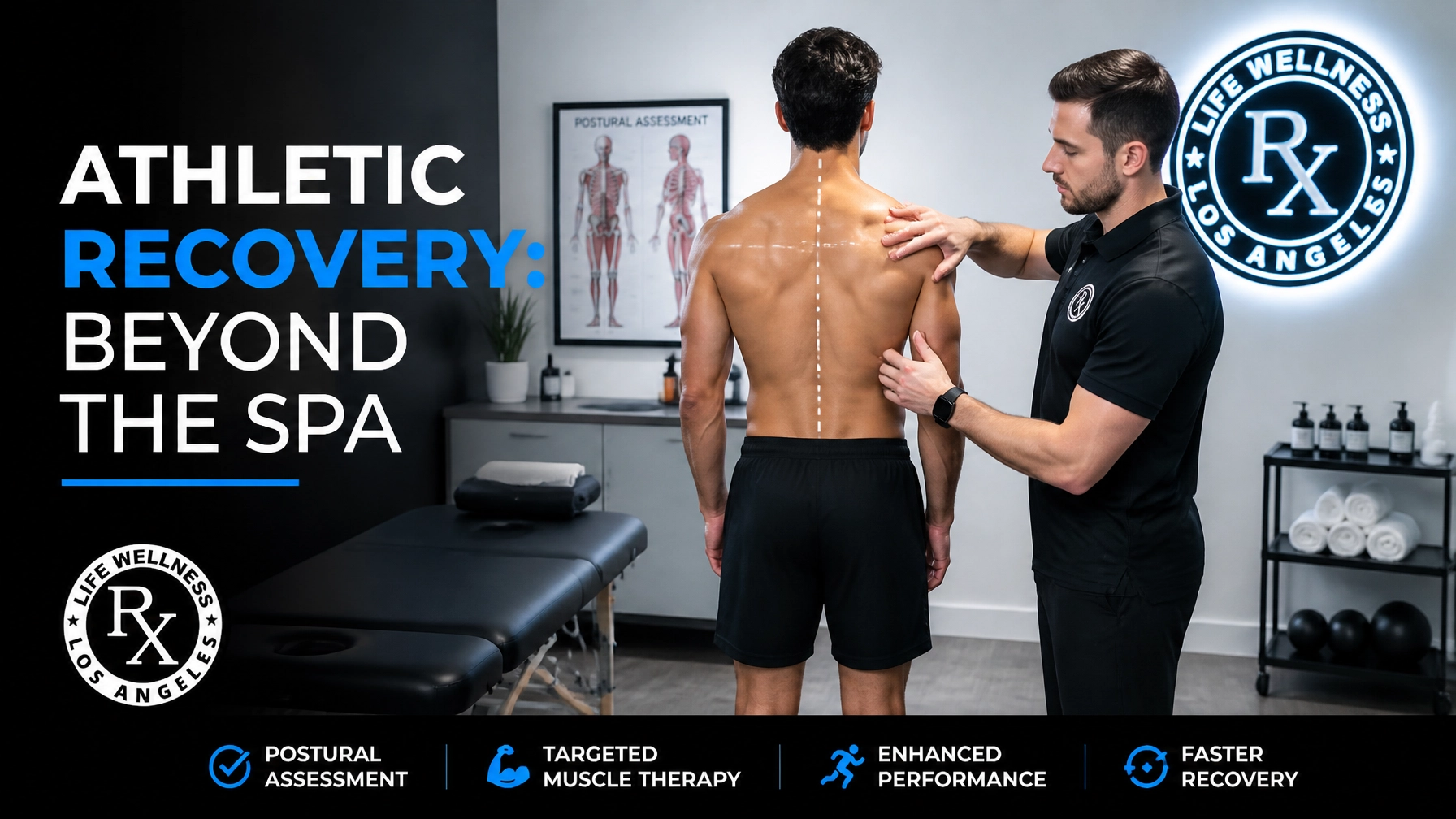
At PhysioMassage Los Angeles, we don’t just poke at your shoulder and call it a day. We’re looking at the whole crime scene, your ribcage, your diaphragm, your breathing pattern, and yes, your posture (because it matters more than you think).
Here’s what we typically find during our initial assessment:
The Evidence:
- Elevated and forward-rolled shoulders
- Visible upper chest movement during breathing (instead of belly movement)
- Tight, rope-like muscles along the sides of your neck (scalenes)
- Upper traps that feel like concrete
- Restricted ribcage mobility
- Shoulder blade (scapula) that barely moves
When we test your breathing, yes, we actually watch you breathe: we’re often shocked by what we find. Most people with chronic shoulder pain are chest breathers, meaning they’ve completely abandoned their diaphragm and are instead hauling their entire ribcage up and down with their neck and shoulder muscles.
THE SCIENCE: WHY STRESS TURNED YOUR SHOULDERS INTO BREATHING MACHINES
Let’s get technical for a moment (but I promise to keep it interesting). Your diaphragm is a dome-shaped muscle that sits beneath your lungs. When it contracts, it pulls down, creating negative pressure that draws air into your lungs. Simple, efficient, elegant.
But modern life had other plans.
Chronic stress, hours hunched over computers, and poor posture have created an epidemic of what we call “accessory muscle breathing.” Your scalenes (small muscles on the sides of your neck) and upper trapezius (those boulder-like muscles on top of your shoulders) are supposed to be backup breathing muscles: only used during intense exercise or when you’re gasping for air.
Instead, they’ve become your primary breathing muscles.

Think about it: If these muscles are contracting 20,000 times per day to lift your ribcage, they’re essentially doing a marathon while you sleep, work, and binge-watch Netflix. The result? Chronic tension, trigger points, restricted blood flow, and pain that radiates into your shoulder.
The research backs this up. Studies show that shallow, chest-based breathing creates compensatory tension patterns that directly trigger shoulder pain with each breath. When your diaphragm is restricted or underactive, your intercostal muscles (between your ribs) and shoulder stabilizers go into overdrive, leading to nerve irritation and that deep, achy pain you can’t seem to shake.
THE CONNECTION: YOUR RIBCAGE IS HOLDING YOUR SHOULDER HOSTAGE
Here’s where the detective work gets really interesting. Your shoulder blade (scapula) doesn’t float in space: it sits on your ribcage. For your shoulder to move properly, your scapula needs to glide smoothly across your ribs. But here’s the catch: If your ribcage is stuck in an elevated position because you’re constantly chest breathing, your scapula can’t move correctly.
This leads to:
- Shoulder impingement (pinching of tendons when you raise your arm)
- Frozen shoulder patterns (progressive stiffness and loss of range)
- Rotator cuff irritation (because everything’s compensating)
- Chronic pain that seems to have no clear cause
It’s a biomechanical nightmare, and it all traces back to how you’re breathing.
THE PHYSIOMASSAGE SOLUTION: TREATING THE REAL PROBLEM
This is where PhysioMassage Los Angeles separates itself from your typical “relaxation spa.” We’re not just rubbing your shoulders and sending you on your way. We’re investigating the root cause and addressing the dysfunction at its source.
Our Treatment Protocol:
DIAPHRAGM RELEASE
We use specialized manual therapy techniques to release restrictions in your diaphragm. This isn’t comfortable work: we’re literally working beneath your ribcage: but the results are astonishing. Clients often report feeling like they can breathe fully for the first time in years.
RIB MOBILIZATION
Your ribs need to move. Each one articulates with your spine and needs to expand and contract with each breath. We systematically mobilize restricted ribs, restoring the mobility that proper breathing: and shoulder function: requires.
ACCESSORY MUSCLE RELEASE
Those overworked scalenes and upper traps? They’re screaming for help. We release the chronic tension, break up adhesions, and help these muscles remember they’re not supposed to be doing all the heavy lifting.

BREATHING RETRAINING
This is the game-changer. We teach you diaphragmatic breathing: how to activate your body’s natural relaxation response, reduce stress-related muscle tension, and improve oxygenation to affected areas. This isn’t woo-woo stuff; it’s evidence-based rehabilitation that stimulates your body’s natural pain-relief mechanisms.
POSTURAL CORRECTION
Because slouching and forward head posture are part of what got you here in the first place, we address the postural patterns that restrict your ribcage expansion and force shallow breathing.
REAL RESULTS: WHAT CLIENTS EXPERIENCE
The transformation is often rapid and substantial. Within the first session, clients typically notice:
- Deeper, easier breathing
- Reduced shoulder and neck tension
- Increased shoulder range of motion
- Less pain with overhead activities
- Better sleep (because they’re not unconsciously tensing all night)
By the third or fourth session, we’re often seeing complete resolution of shoulder pain that’s plagued people for months or even years. Why? Because we’re not treating symptoms: we’re solving the mystery and fixing the actual dysfunction.

THE VERDICT: YOUR SHOULDER NEEDS YOU TO BREATHE
Here’s the uncomfortable truth: Most shoulder pain isn’t actually a shoulder problem. It’s a breathing problem, a posture problem, and a stress problem that manifests in your shoulder because that’s where the body finally breaks down under the accumulated tension.
The best news? This is fixable. Not with surgery, not with endless pills, but with skilled manual therapy that addresses the root biomechanical dysfunction and teaches your body how to move: and breathe: correctly again.
Sometimes the best way to fix your shoulder is to learn how to breathe again. It sounds almost too simple, but that’s what makes it so powerful.
READY TO SOLVE YOUR CASE?
PhysioMassage Los Angeles offers clinical-grade, medical massage therapy that goes far beyond standard treatment. Our approach integrates manual therapy, postural assessment, and functional movement analysis to get you real, lasting results.
Pricing:
- $220 for In-Home Sessions (perfect for busy professionals across LA)
- $140 for Clinic Sessions in Glendale
Book your session at https://massagerxla.com/ or call (209) 273-5376 to schedule your initial consultation.
Want to dive deeper into therapeutic techniques? Watch Our Class on YouTube at https://www.youtube.com/@LifeRxWellness, or join our Masterclass on Patreon at https://www.patreon.com/c/liferxhealth for exclusive content on pain relief and body mechanics.
We serve clients throughout Los Angeles, including specialized in home massage Los Angeles services in North Hollywood, Hollywood, and beyond. For targeted shoulder pain therapy, visit https://massagerxla.com/shoulder-pain-therapy.
The case is clear: Your shoulder pain is waiting to be solved. Are you ready to crack the case?



Leave A Comment